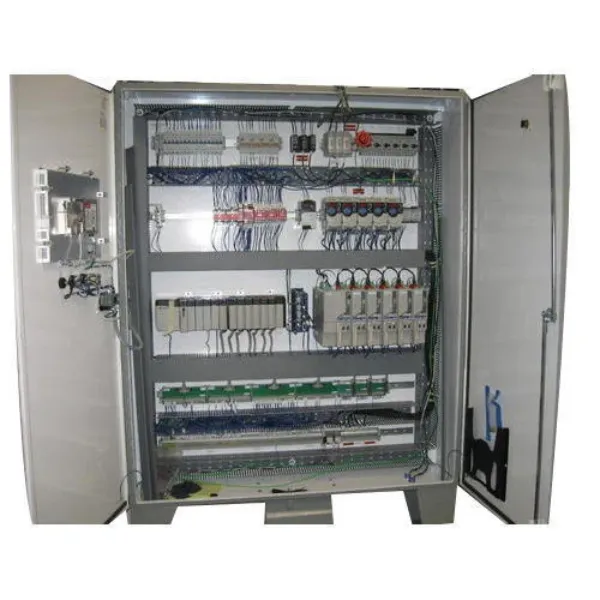
Automation panels form the control center for many production machines and industrial processes. A PLC panel can coordinate motors, sensors, valves, actuators, safety devices, drives, and operator commands, but its effectiveness depends heavily on how clearly the control requirement is defined before design begins.
For manufacturing and engineering companies in Karur, Tamil Nadu, preparing a detailed specification can reduce ambiguity between the machine builder, automation integrator, electrical team, and panel supplier.
Define the Process Before Defining the Hardware
The first step is understanding what the machine needs to do.
A process description should identify the sequence of operations, operating modes, interlocks, alarms, safety conditions, and manual functions.
Without this information, selecting PLC hardware becomes largely speculative.
A useful specification may include:
- Process sequence
- Digital inputs and outputs
- Analog signals
- Motor controls
- VFD integration
- Temperature or pressure control
- Communication requirements
- HMI functions
- Alarm philosophy
- Future expansion needs
Prepare an Accurate I O List
The input-output list provides the foundation for PLC sizing.
Inputs may come from push buttons, limit switches, proximity sensors, level switches, pressure transmitters, temperature sensors, and other field instruments.
Outputs may operate contactors, solenoid valves, indicators, alarms, and other devices.
Spare I/O can be considered where realistic future expansion is expected.
Specify Communication Requirements
Modern automation systems often require multiple devices to exchange information.
A PLC may need to communicate with VFDs, HMIs, remote I/O, energy meters, supervisory systems, and other controllers.
Communication protocols and network architecture should therefore be established early in the project rather than added after panel construction.
Panel Environment Matters
Industrial panels must suit the location where they will operate.
Dust, heat, humidity, vibration, corrosive conditions, and washdown requirements can affect enclosure selection and internal component arrangement.
Heat generated by VFDs, power supplies, transformers, and other components should also be considered when planning ventilation or cooling.
Documentation Should Be Part of Procurement
A completed control panel is more useful when maintenance teams receive suitable documentation.
Depending on project scope, documentation may include electrical drawings, terminal details, I/O schedules, component lists, PLC backups, HMI backups, and operating information.
These records become valuable when troubleshooting years after commissioning.
Perfect Engineering Solutions works with industrial control, motor, drive, and power transmission requirements. Companies around Karur evaluating a PLC panel can make procurement more effective by preparing process details and equipment interfaces before requesting a final configuration.
A good control panel begins with a good specification. Clearly defining process logic, I/O, communication, safety requirements, environmental conditions, documentation, and expansion expectations gives automation engineers a stronger foundation for designing a system that can be commissioned and maintained efficiently.
Keywords