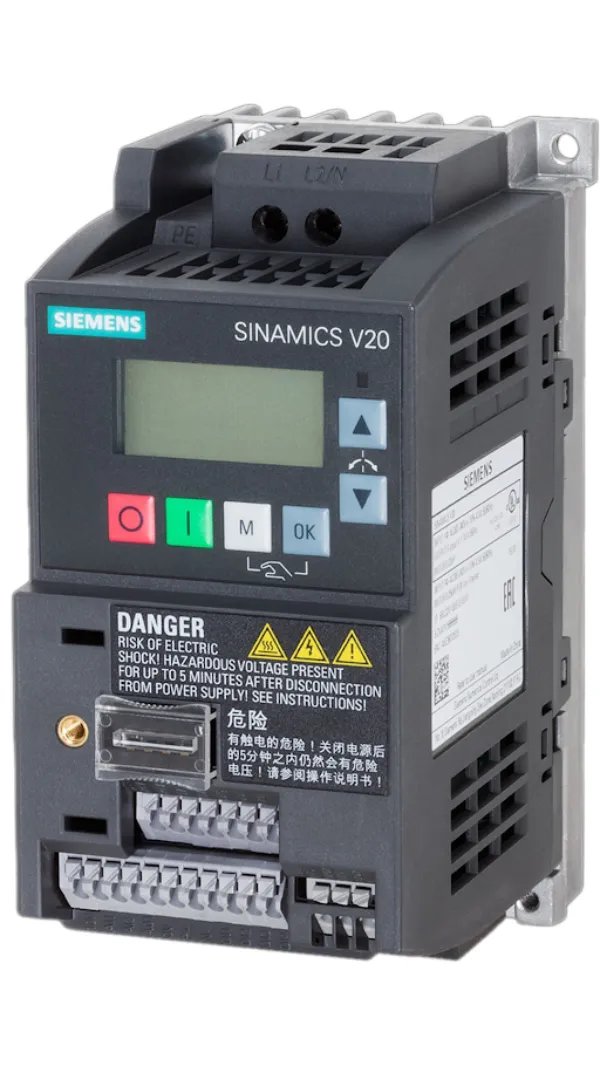
Selecting a variable frequency drive for an automated machine requires more than matching a drive's power rating with the motor nameplate. A Siemens VFD should be chosen according to motor current, load characteristics, control requirements, communication architecture, and the operating environment.
For machine builders and automation integrators in Hosur, Tamil Nadu, these details are particularly important because drive selection affects both machine performance and integration with the wider control system.
Identify the Load Type First
Different machines place different demands on motors.
Fans and centrifugal pumps generally behave as variable-torque loads. Conveyors, mixers, and many production machines can behave more like constant-torque applications.
Some machines also require high starting torque, rapid acceleration, frequent speed changes, or temporary overload capacity.
The drive needs to be selected according to these real load characteristics.
Use Motor Current as a Key Selection Parameter
Motor kW provides an initial reference, but rated current is crucial when matching the drive.
Engineers should compare the motor nameplate current with the drive's applicable output-current rating under the intended duty conditions.
Derating may need consideration where ambient temperature, altitude, switching frequency, or enclosure conditions differ from standard rating assumptions.
Define the Required Control Performance
A basic conveyor may need straightforward speed control. A more demanding machine may require tighter torque response, sensor feedback, multiple speed references, braking, or coordinated control.
Before ordering, establish what the drive actually needs to accomplish.
Useful questions include:
- What speed range is required?
- How quickly must the motor accelerate?
- Is rapid deceleration necessary?
- Is braking required?
- Does the PLC provide the speed reference?
- Is feedback control needed?
- What communication network is used?
These answers influence both drive configuration and associated equipment.
Consider Panel Integration
A drive installed inside an automation panel generates heat and needs appropriate spacing and ventilation.
Cable routing is also important. Power cables, motor cables, control wiring, and communication wiring should be arranged according to good electrical engineering practices and manufacturer recommendations.
Electromagnetic compatibility can become particularly important in machines containing sensitive instrumentation and communication systems.
Plan Commissioning Before Installation
Correct parameterization is essential.
Motor data, acceleration and deceleration times, minimum and maximum frequencies, current limits, control mode, digital inputs, analog signals, communication settings, and protective functions should be configured according to the application.
Perfect Engineering Solutions supports machine builders and manufacturing businesses with industrial motors, VFDs, control panels, gearboxes, and related drive equipment. For projects around Hosur involving a Siemens VFD, sharing the motor nameplate, machine function, load profile, PLC architecture, and required speed range can help establish a more application-specific requirement.
Drive selection should be treated as part of machine engineering rather than component procurement alone. When electrical sizing, mechanical load, automation requirements, communication, panel design, and commissioning are considered together, the VFD can become an effective part of the overall motor-control system.
Keywords