An industrial panel must do more than distribute electricity: it must divide incoming power into correctly protected circuits, withstand the available fault current, and let operators isolate equipment safely. By the end, you will know how to distinguish panel types, size the assembly, specify feeders and protection, and check whether a proposed design is suitable for your site.
Key takeaways
- Choose the panel type from your supply, load arrangement and required isolation points.
- Size the incomer for calculated demand, fault level and future capacity.
- Match each feeder’s breaker, cable and overload protection to its load.
- Demand SCCR, enclosure details, VFD isolation provisions and test documents before purchase.
What a Power Distribution Panel Does—and Which Panel Type You Actually Need
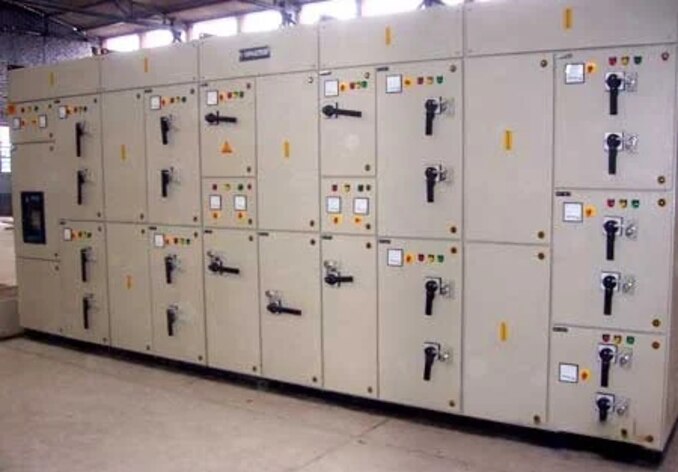
A power distribution panel receives electrical power at one point and sends it through separately protected feeders to motors, heaters, lighting, VFDs, and plant auxiliaries. It provides isolation, overcurrent protection, busbar distribution, metering, and a clear circuit schedule; it does not automatically control every connected machine.
Choose the panel by the job it performs, not by its appearance.
| Option | What it does | Correct choice | Wrong choice |
|---|---|---|---|
| Main distribution board | Accepts the plant incomer and feeds major sections | Factory-wide distribution from the utility or transformer | A small machine with only a few local circuits |
| Sub-distribution board | Feeds a defined area from the main board | A workshop, production line, or building zone | The plant incomer or a motor-control group |
| Motor control centre (MCC) panel (MCC) panel | Groups motor starters, overloads, isolators, and controls | Several fixed-speed motors requiring central operation | A panel whose main load is VFDs or general socket and lighting circuits |
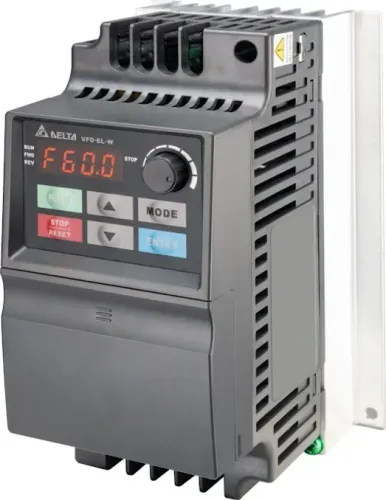
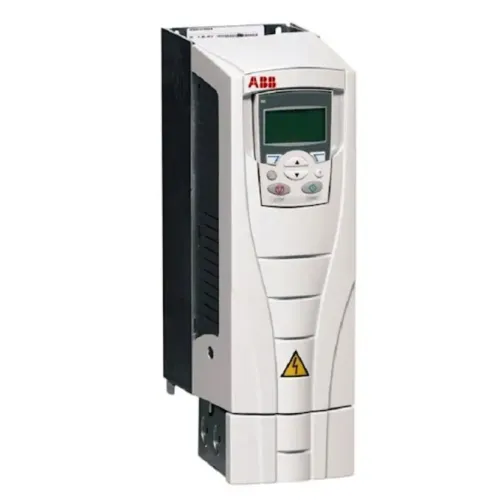
| VFD panel | Houses drives and their associated protection and control | Multiple variable-speed motors with drive-specific layout needs | A replacement for an entire plant distribution system |
| PLC panel | Houses the controller, I/O, relays, and control power | Automation and sequencing | Directly supplying large motor power circuits |
| Automatic power factor correction panel | Switches capacitor steps to correct reactive demand | Loads with measured, stable inductive demand | A system dominated by VFDs without checking harmonics and resonance |
Check the schedule for every feeder’s load, protective device, conductor, control voltage, starter or VFD, and spare route. A spare breaker is not usable capacity until its bus rating, heat effect, SCCR, and cable space are confirmed. The panel’s SCCR must meet available fault current; its ampere rating alone proves nothing.
How to Size the Panel and Select Its Incomer
1. List every feeder and motor circuit in the panel schedule, including load, protective-device type and rating, conductor size, control voltage, starter or VFD identification, and planned spare ways. Total the connected load in kW or kVA, then apply the diversity factor to obtain the maximum demand.
Size the busbar and incomer for that demand, not merely the sum of nameplate ratings.
2. Check the worst operating condition, including motor starting current and DOL start current. A large DOL motor can cause voltage dip or trip the incomer while running loads are within rating. Confirm the starting sequence, transformer capacity, voltage-drop limit, and whether staged starting or a soft starter is needed.
Calculate full-load current from the maximum-demand kVA and system voltage, then select the next suitable continuous current rating.
3. Reserve spare capacity as future load, busbar capacity, enclosure space, heat allowance, and cable-routing space—not just empty breaker positions. A physically installed “spare” breaker is not useful unless its bus rating, SCCR contribution, terminals, and future wiring route are confirmed.
4. Obtain the prospective short-circuit current at the installation point. The panel SCCR must meet or exceed it; SCCR is separate from the incomer’s ampere rating. In a UL 508A assembly, the lowest-rated series component can limit the panel SCCR unless an approved combination raises it.
5. Use a main switch for isolation where upstream fault protection is adequate, an MCCB for moderate ratings and adjustable protection, an ACB for high current and selective settings, and a switch-fuse where reliable fuse breaking capacity is required.
Choose three-pole or four-pole switching according to whether the neutral must be switched, such as supplies involving generators or alternative sources.
How to Specify Feeders and Coordinate Protection
Give each load its own outgoing feeder when a fault, maintenance shutdown, or starting event must not affect unrelated equipment. Size the feeder conductors and protective devices for the load, installation method, available fault current, and required disconnection time—not simply the panel’s main rating.
1. Classify the load before selecting protection. A motor feeder needs a starter or VFD, motor overload protection set against the motor’s rated current and service conditions, and separate short-circuit protection for fault clearing and conductor protection. A breaker sized only from the nameplate can nuisance-trip during starting or leave the motor inadequately protected.
2. Protect non-motor loads according to their failure mode. Use dedicated feeders for heaters, socket outlets, control transformers, and sensitive electronics; select their breaker curves and ratings for inrush and continuous current. Add earth-fault protection (RCD) where shock protection, leakage current, or local rules require it, checking compatibility with VFD leakage and nuisance-tripping risks.
3. Coordinate devices from the load toward the incomer. Choose downstream breakers with lower pickup or faster clearing characteristics, then verify time-current curves, let-through energy, and manufacturer-tested combinations. A downstream fault should trip its feeder device first, leaving the busbar and other production circuits energised.
4. Record feeder identification, load, device type and rating, conductor size, control voltage, starter or VFD reference, and genuine spare ways in the panel schedule. Do not label installed breakers “spare” until bus rating, SCCR, heat, physical space, and future cable routing have been checked.
Busbars, SCCR, Enclosures, and Verification: The Safety Details That Decide the Design
A 400 A main switch does not make a panel safe against a 35 kA fault. Record the prospective short-circuit current (SCCR) at the installation point, then specify a panel SCCR at least equal to it; SCCR is not the main disconnect’s ampere rating.
In a UL 508A industrial control panel, the lowest-rated series-connected component can set the SCCR unless an approved combination or tested assembly allows a higher value.
Busbar ampacity and short-time withstand current are separate checks. A copper busbar and an aluminium busbar need suitable cross-section, joints, supports, spacing, and temperature-rise verification for the continuous load and fault duty. Loose joints create hot spots; inadequate supports let fault forces deform the bars.
Select the enclosure for the actual environment. Dust, washdown, corrosive vapour, impact, and indoor or outdoor exposure determine the required IP or NEMA construction. VFDs, transformers, contactors, and warm surroundings add heat; a sealed enclosure may need derating, more volume, a heat exchanger, or an air conditioner.
An unfiltered fan can destroy a dust or washdown rating.
Before installation, demand evidence that the assembly was verified, not merely filled with compliant parts:
- IEC 61439-1/-2 verification covering temperature rise, dielectric properties, short-circuit withstand, clearances, creepage, protective-circuit continuity, and mechanical operation.
- A bonded protective-earth path across doors, gland plates, and removable sections.
- An updated SCCR and arc-flash label after any breaker, fuse, trip-setting, transformer, or enclosure change.
VFD Feeders, Safe Isolation, and the Documents to Demand Before Purchase
A VFD feeder needs more than an MCCB and cable. The drive draws nonsinusoidal current, creates heat, and can introduce harmonics, voltage drop and resonance with an automatic power factor correction (APFC) panel. Specify a line reactor or harmonic filter only after a load-flow or harmonic study; each adds losses, cost and voltage drop.
Removing the incomer does not prove a safe VFD panel. The DC bus and capacitors can remain charged, while control transformers, auxiliary supplies, regeneration or connected equipment can backfeed the circuit.
Demand these items before purchase:
- A single-line diagram and GA drawing showing incomer, feeders, bypasses, earthing, segregation, cable entries, ventilation and maintenance access.
- A feeder schedule naming every motor, VFD, protective-device type and rating, conductor size, control voltage and genuine spare ways.
- SCCR or short-circuit withstand rating, busbar rating, enclosure IP or NEMA rating, heat-loss calculation and ambient-temperature derating.
- Design-verification records to IEC 61439-1 and IEC 61439-2, including temperature-rise, dielectric, short-circuit, protective-circuit, clearance, creepage and mechanical-operation checks.
- Factory test reports for insulation resistance, continuity, dielectric withstand, functional interlocks and VFD control.
Panel choice changes the safeguards:
| Panel | Primary function | Do not substitute it for |
|---|---|---|
| VFD panel | Variable-speed motor control | A PLC panel or APFC panel |
| PLC panel | Logic, signals and automation | Motor short-circuit protection |
| APFC panel | Reactive-power correction | Harmonic mitigation for VFDs |
Require lockout/tagout instructions that isolate, discharge, restrain and test stored energy with a suitable meter. Perfect Engineering Solutions can help match motor feeders to the correct drive and protection schedule.
Frequently asked questions
What does a power distribution panel do?
It receives power at one point and distributes it through separately protected feeders to motors, heaters, lighting, VFDs and auxiliaries. It also provides isolation, overcurrent protection, busbar distribution, metering and circuit identification.
How do you size a power distribution panel incomer?
Calculate the connected and maximum demand loads, account for motor starting and diversity, check the supply voltage and phase arrangement, then verify the incomer rating against cable capacity, fault level and planned expansion.
What protection does each panel feeder need?
Select the feeder breaker or fuse, cable, overload protection and isolation method for the connected load. Motor feeders also require protection suited to starting current and the motor’s full-load current.
What should you verify about busbars, SCCR and the enclosure?
Check the busbar material and rating, short-circuit current rating, enclosure IP or NEMA classification, earthing arrangement, internal separation and the manufacturer’s test or verification documents.
What documents should you demand before buying a panel?
Request the single-line diagram, load schedule, circuit schedule, datasheets, incomer and feeder ratings, SCCR documentation, enclosure rating, wiring drawings, test reports and VFD isolation details.